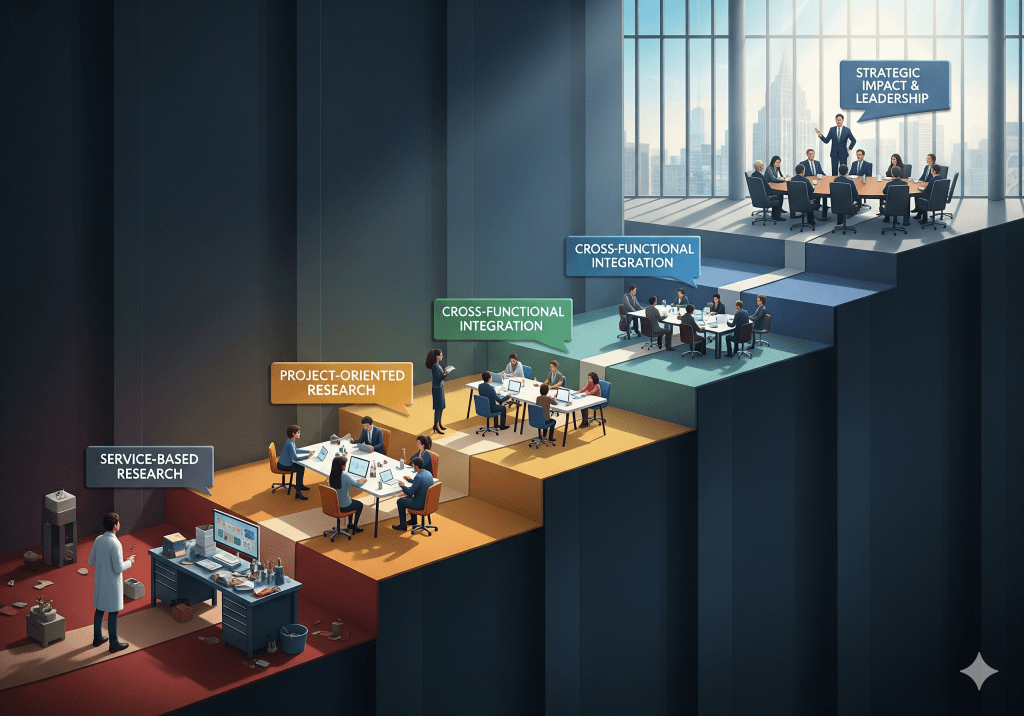
When working inside a large corporation, advancing UX research maturity is both a challenge and an opportunity. Unlike startups where influence can be immediate, in a large organization the impact of UX research depends on visibility, stakeholder relationships, and sustained advocacy. Building a mature research practice isn’t just about methods and deliverables—it’s about creating a culture where customer insights guide decision-making at every level.
Why UX Research Maturity Matters
A mature research practice ensures that product teams don’t rely on assumptions or best guesses when making strategic decisions. Instead, decisions are grounded in real customer needs and behaviors. This maturity benefits not only design and product teams but also executives who need confidence that their investments align with customer value.
In my experience, moving toward maturity requires two parallel tracks:
- Strategic leadership – shaping how research is perceived and prioritized at the organizational level.
- Tactical delivery – demonstrating the tangible value of research through real product impact.
Both tracks must be advanced together to create lasting change.
Building Relationships with Stakeholders
One of the most effective strategies my team has employed is intentionally cultivating strong relationships with stakeholders. In large organizations, decision-making is often distributed and political. By connecting directly with product managers, engineers, and executives, we ensure research is not only heard but acted upon.
We approach relationship-building in three ways:
- Listening First – Before offering insights, we make space to understand stakeholders’ goals, pressures, and success metrics.
- Aligning to Business Priorities – We frame research questions in terms of organizational goals (e.g., market growth, efficiency, customer retention), showing that research is not an academic exercise but a business driver.
- Collaborative Research Journeys – Rather than presenting findings at the end, we involve stakeholders throughout the process—attending sessions, co-creating hypotheses, and interpreting results together.
This collaborative approach transforms research from a one-time report into a shared journey toward understanding customers.
Case Study: Partnering with Engineering on New Product Introduction
A recent engagement with an engineering team illustrates how these principles come to life. The team was working on a new product introduction, and it was clear from the beginning that research could play a defining role. To signal that we recognized this work as a priority, I made the decision to hire a dedicated contractor. This ensured we had the bandwidth to meet engineering’s needs while continuing to support other high-impact initiatives across the company.
The collaboration unfolded in phases:
- Personas as a Foundation – We began by defining existing personas and even developing a new one to capture an overlooked customer segment.
- Interviews for Depth – Next, we conducted interviews to understand how this new persona would use the product and how they interacted with established personas.
- Expanding the Partnership – Energized by the insights, the engineering team began requesting additional studies. We moved beyond discovery into helping define features, workflows, and interaction models.
- Prototype Testing – Today, we’re conducting usability studies on early prototypes, directly shaping product design ahead of launch.
- Sustained Maturity – Once the product launches later this year, we plan to conduct iterative benchmark testing to measure and optimize the real-world user experience.
The result? We’ve built a strong, trusted relationship with this engineering team. They now view UX research not as a service that validates ideas, but as a strategic partner shaping product direction from the ground up.
Thought Leadership: Scaling Maturity Beyond One Team
While this case study highlights one successful partnership, the bigger story is how these relationships scale across the organization. Each collaboration creates momentum. Advocates emerge. Leaders begin to expect research as part of the process, not as an optional add-on.
Some strategies we’ve found effective in scaling maturity include:
- Showcasing Impact – Sharing stories (like this engineering partnership) that demonstrate how research directly influenced outcomes.
- Scaling Communication – Delivering insights in multiple formats (dashboards, briefs, executive presentations) so they resonate across audiences.
- Embedding Research in Culture – Offering lightweight workshops and enablement sessions so teams outside UX can apply customer-centric thinking in their own work.
Looking Ahead
Advancing UX research maturity is not about racing toward a finish line. It’s about consistent, intentional steps that integrate customer insights into the organization’s DNA. Sometimes that means strategic decisions—like staffing a dedicated researcher to show commitment to a priority initiative. Other times it means tactical wins—like helping an engineering team shape features and test prototypes before launch.
For me, the goal is always the same: ensuring that customer voices aren’t just heard, but are shaping strategy, driving innovation, and ultimately creating products that matter.




Leave a comment